

kickball
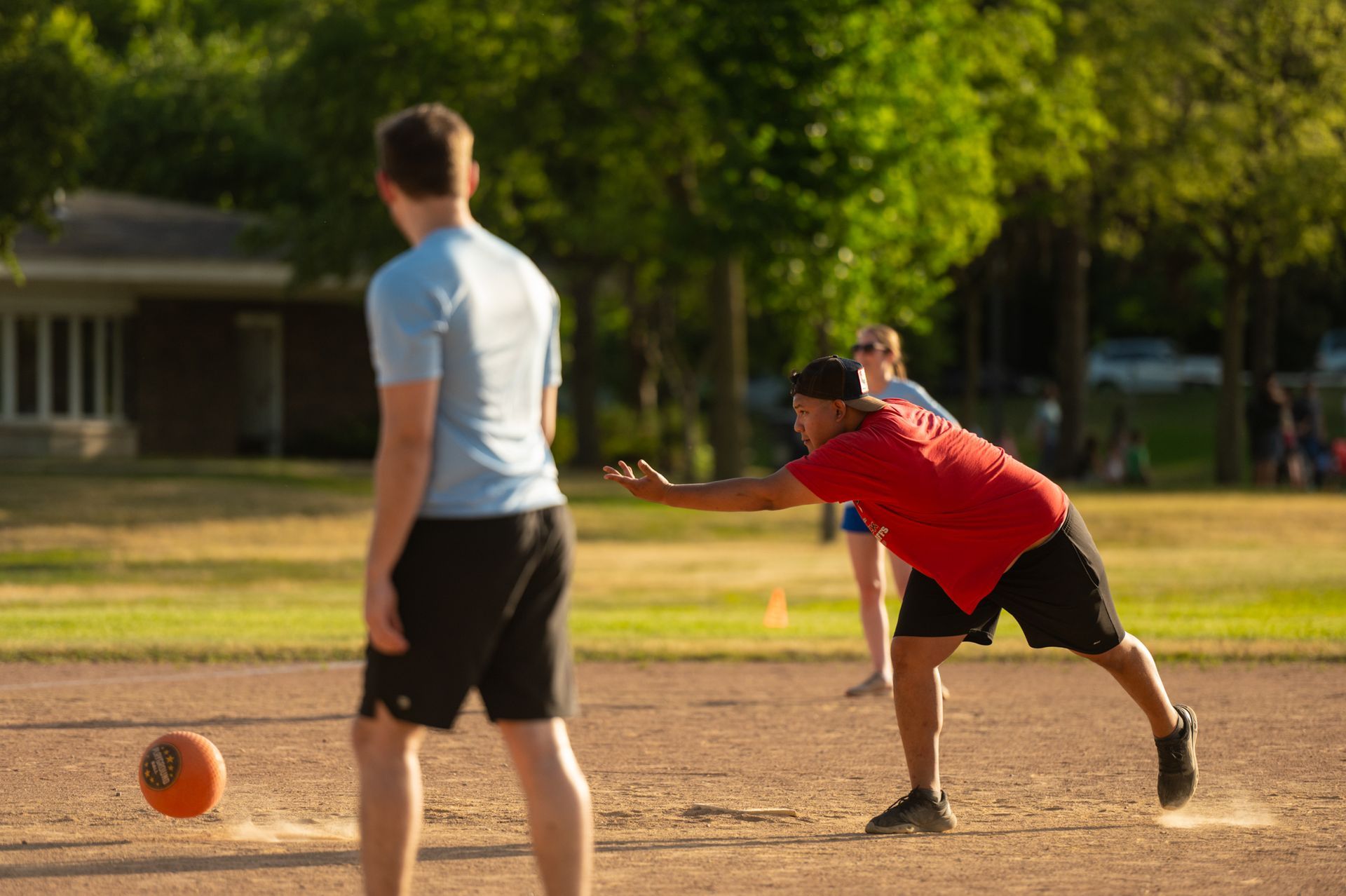
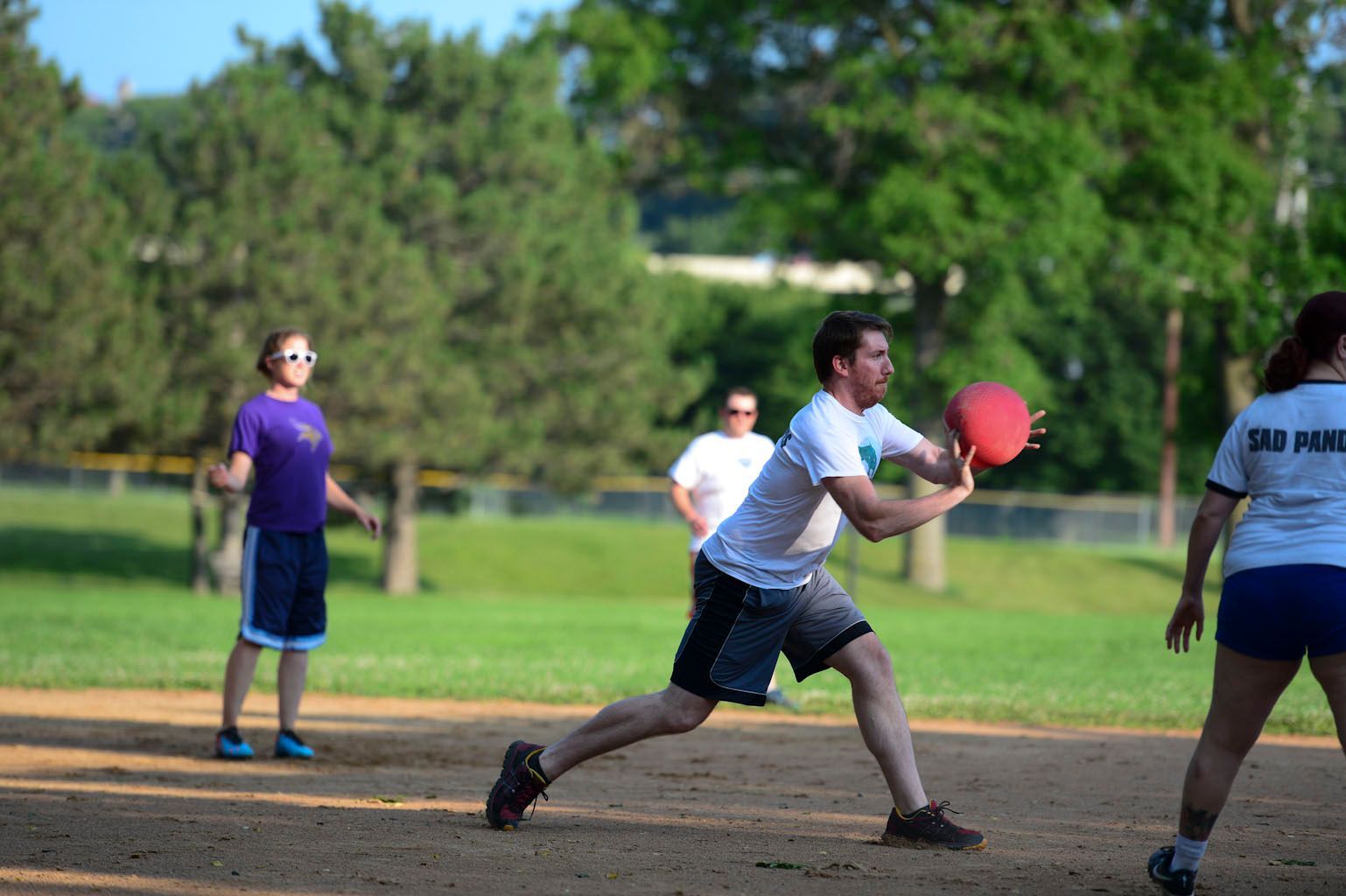
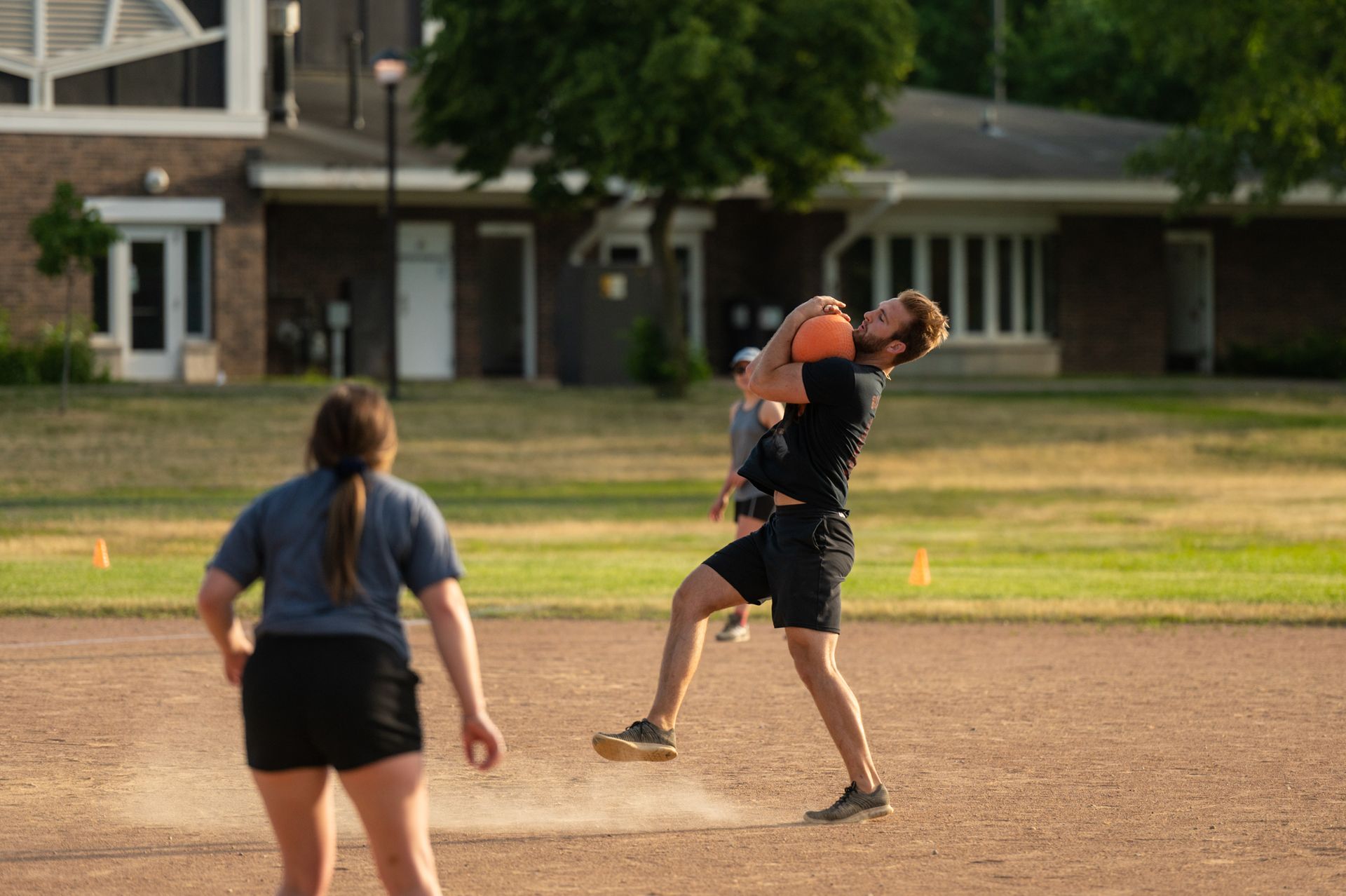
Relive Recess: Join a kickball League
Spring registration opens in February
Fall registration opens in June

Program Information
League Information
- Ages 18+
- 11 people per team (no more than 20)
- Spring Season: April-July
- Fall Season: August-October
- Schedules will be available (at a minimum) two weeks before the season starts
- League fees vary based on league
- Leagues will be officiated (MPRB Certified Officials)
League Games and Times
- Leagues are offered Monday-Thursday
- Match times for evening leagues may be scheduled between 6pm-10pm
Registration Options
Team Registration
Minneapolis Park and Recreation Board (MPRB) Divisions:
- Open: leagues without gender restrictions for play and field position
- Co-Ed: players identity as female/male with gender rues in place for play and field position
MPRB Skill Levels:
- Recreational: A laid-back approach to your kickball experience; a social atmosphere geared toward the fun and recreational aspects of the game of kickball
- Competitive: A more serious approach to the game, a higher level of play. Ideal for previous league champions and/or experienced teams looking for a higher level of competition.
Rosters:
- All players must be 18 years or older
- Minimum number of players on a team is 11
- Maximum number of players on a team is 20
Individual Registration
- We accept individual registration for kickball
- Learn more and register through our individual registration process
MPRB League Rules
Minneapolis Park and Recreation Board (MPRB) House Rules:
Kickball is actually very similar to softball and baseball. The object is to advance more runners across home plate than the opposing team. USA Softball slowpitch softball rules are the basis of the MPRB kickball rules. Any rule not defined below will be similar to the rule found in the USA Softball rule book.
Rosters:
- All players must be 18 years or older
- Minimum number of players on a team is 11
- Maximum number of players on a team is 20Teams:
- Each team must roster at least 11 players and at most 20 players
- Females and males must be equally represented in both the infield and the outfield when possible
- If fielding the minimum of eight players (four male/four female or five female/three male), that team should place three players in the outfield and the remaining five in the infield (first, second, third base, pitcher and catcher)
- If fielding the maximum of 10 players (five male/five female), four players must play in the outfield, while the remaining six will play the infield (first, second, third, shortstop, pitcher, and catcher)
- Pitcher and catcher must be of different genders
- If a team cannot field at least three men (with five women), that team will forfeit the game
- Teams will have a five-minute grace period before a forfeit is declared
- A floating kicking order will be used when an odd number of male/female players are in the kicking order
- You should never have the same sex kick back-to-back
- In the field, there will never be more than five male fielders. The following ratios for male/female are acceptable for the field:
- three male/five female
- three male/six female
- three male/seven female
- four male/four female
- four male/five female
- four male/six female
- five male/five female
- five male/four female
- All players playing the field must be in the kicking order
- Any players that are not playing the field can still be in the kicking order but must remain so during the course of the entire game
- All team players must kick in a consistent kicking order
- If you have kicked at least once, you must stay in that same kicking order, unless you are injured
- Kickers are allowed to but and infielders can move as close to the plate as they would like
- There is no imaginary line that fielders must stay behind as long as they remain in fair territory
- Catchers MUST be in foul territory BEHIND the kicker when the ball is kicked (failure to do so is Catcher Obstruction)
Game Play:
- A managers' meeting will take place before the game with the umpire to cover ground rules
- Regulation games last nine full innings or 55 minutes (whichever comes first)
- In the event of a tie score at the end of the game, the game will be marked as such
- If time allows, an extra inning may be played if both teams agree to it
- If both teams scheduled to play each other forfeit the game, the game will be marked as a 0-0 tie. Each team will get one point for the tie.
- A game that is called off by the umpire or League Director due to inclement weather before three full innings of play will not be considered a regulation game
- The game may be rescheduled or resumed at the point that the game was stopped, if possible
- The first two games lost due to weather are not made up
- There will be a seven-run rule in effect per team per inning
- When a team scores seven runs in one inning (even if the team has fewer than three outs), they must stop kicking and switch places with the other team
- This rule is in effect for all innings except the ninth inning as called by the umpire (in those innings unlimited runs may be scored)
- A runs ahead rule will be used as follows:
- 20 runs after four innings or 10 after five innings
Ball in Play:
- When a defensive player in the infield has control of the ball, the play ends
- If a runner intentionally touches or stops the ball, even if they are on base, the play ends (the runner will also be called out)
- Players in the field are allowed to kick the ball (as opposed to throwing) towards another team player in the field
- This is particularly helpful if you have a long throw from the outfield
- There is no infield fly rule
- If the the umpire feels a ball is intentionally dropped to turn a double play, the kicker is out and all runners will return to the last base occupied
- The catcher may not impeded the ability of the kicker to put the ball in play
- Catcher Obstruction: a delayed dead ball call by the umpire that happens when a catcher is in front of the kicker at the time the ball is kicked or hinders the kicker's ability to kick the ball
- If obstruction is called and the kicker reaches first base safely and all other runners advance at least one base, the obstruction is cancelled and all action stands
- If all runners and the kicker do NOT advance at least one base safely, the manager of the offensive team has the option of taking the result of the play or placing the kicker at first base and advancing runners only if forced
Pitching:
- Pitchers must "Roll" the ball to the kicker
- A pitched ball must first contact the ground after leaving the pitcher's hand, no more than three feet from the hand, as judged by the umpire
- A pitched ball that bounces higher than one foot multiple times before reaching home plate, also as judged by the umpire during or after the pitch, results in an illegal pitch
- The strike zone extends one foot on either side of home plate and one foot high
- Any part of the ball over the strike zone, as judged by the umpire, will be a strike
- If the ball falls short of the plate and does not cross over, the pitch will be called a ball
- The pitcher must have at least one foot on or both feet behind the pitching plate until the ball is kicked
- Failure to do so results in an illegal pitch
- Pitchers may only be replaced twice per inning
Kicking:
- The order of kicking shall be alternating male and female players
- No player may kick more than once until the entire team rotation per genders has had a chance to kick
- To preserve the male-female alternating kicking order, it may be necessary to have one gender kick more than once
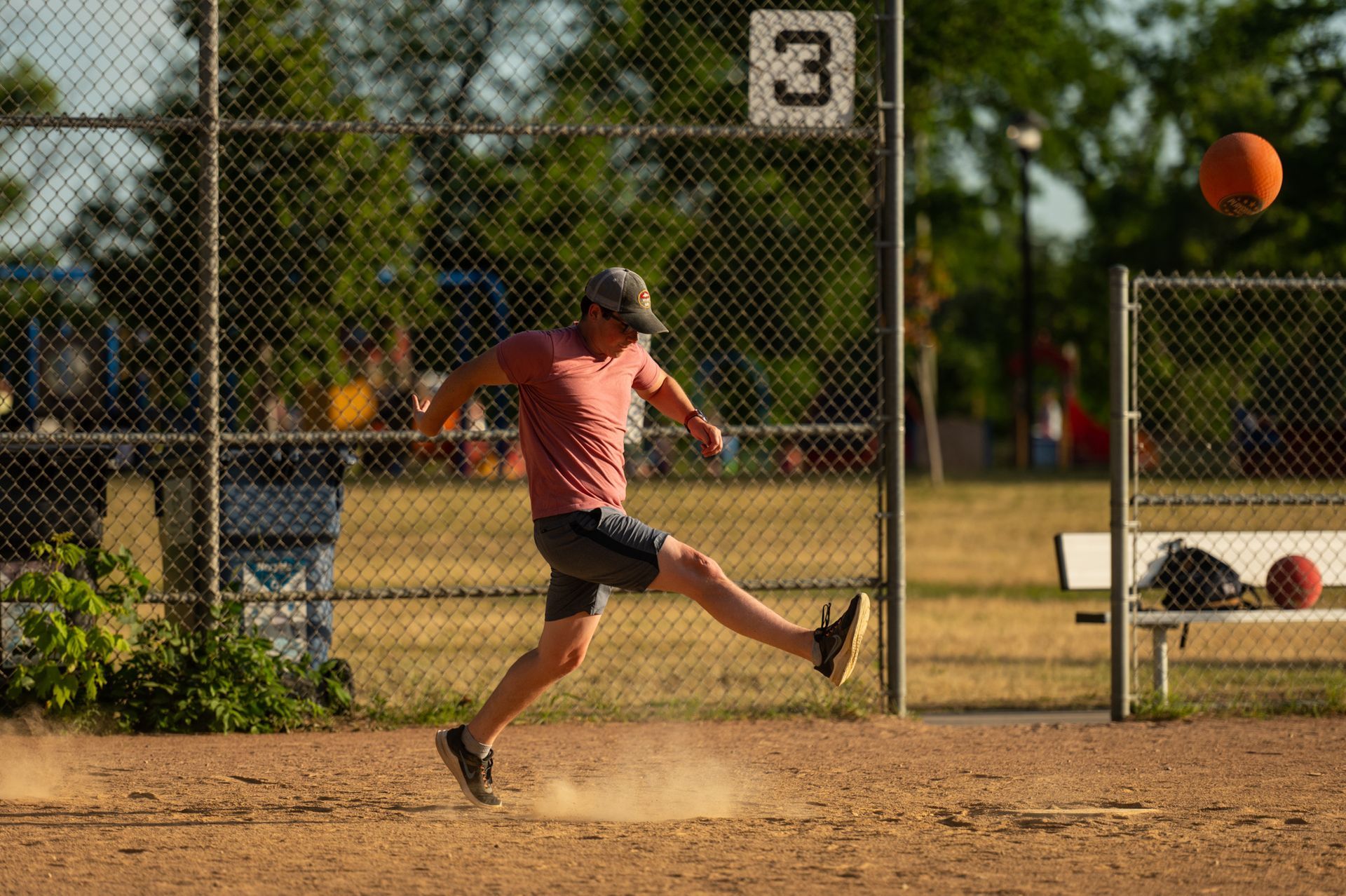
- All kicks made with the leg, at or below the knee, result in a live ball
- Any ball "kicked" above the knee or stepped on, intentionally or unintentionally, is a considered a foul ball
- If a "legal" kick is made and the ball contacts the kicker a second time while behind the home plate, the result is a foul ball
- All kicks must occur at or behind the front edge of the front plate
- If any part of either foot touches the ground past the front edge of home plate prior to the kick of the ball, the kicker will be called out
- As in Co-Rec softball, a walk to a male kicker will result in a two base award
- The next kicker (a female) shall kick
- With two outs, the female has the option to walk or kick. Should the female choose to walk and pass the previous male kicker, while on his way to first, no out shall be called during this dead ball period
- A male kicker advancing to second base without touching first base shall be called out if properly appealed
Base Running:
- Runners must stay within the base line
- Fielders trying to make an out on base may have their foot on base but must not impede the runner, especially if the fielder does not have the ball
- Runners hindered by any fielder within the base line shall be safe to which they were running
- A runner is out when they run outside the three-foot lane and, in the umpire's judgement, interferes with the fielder taking the throw at first base
- The runner may run outside the three-foot late to avoid a fielder attempting to field a kicked ball
- When the defensive player, due to an errant throw, uses the foul portion of the double base, the runner can run in fair territory when the throw is coming from the foul side of first base
- If intentional interference is ruled with a kicker or thrown ball, the runner is out
- The play ends when all runners have completed their base running and a defensive player has control of the ball in the infield
- When, in the judgement of the umpire, all immediate play is apparently completed, the umpire will call time
- Neither leading of nor base stealing is allowed
- A runner off of their base when the ball is kicked will be called out
- Sliding is allowed
- If a base runner advances i front of another runner or touches the runner in front of them, they will be called out
- Hitting a runner with the ball above shoulder level is not allowed
- Any runner intentionally hit above the shoulders as they are running or sliding to a base will be safe
- If contact first occurs below the shoulder and secondar contact is made above it, it is NOT an out
- If a player intentionally throws at the head of another player, they will be ejected
- If a player demonstrates unsportsmanlike conduct, as judged by the umpire, with an excessively hard throw or other act of aggression, they may be ejected
- If the runner intentionally uses their head to block the ball, the runner is out
- After a ball is caught, runners must tag (go back to) their originating base before running to the next base
- One extra base is awarded on an overthrow or kick by a defensive player
- Any ball that crosses the line of play line, as established by the umpire, is considered an "overthrow"
- All attempts necessary should be made to avoid a collision with the catcher during plays at the plate
- Any player may not "block" any base without the ball in their hands
- Catchers need to know where they are standing to avoid unnecessary collisions
Definitions:
- Strikes: any foul ball or a pitch within the strike zone, as defined above, either not kicked, or missed by the kicker
- Balls:
- A pitch outside the strike zone
- A ball falling short of the plate and does not fully cross over the plate
- A pitch that bounces higher than one foot multiple times before reaching home plate, as judged by the umpire
- A pitcher advancing in front of the pitching plate before the ball is kicked
- Any catcher advancing forward of home plate before the kicker kicks the ball
- Fouls:
- A kicked ball landing fair but ending up in foul territory without being touched before reaching first or third base
- Any ball touched by a fielder while the ball is in fair territory is automatically fair even if the ball goes foul
- Count: Each kicker will be allowed a three ball and two strike count with no courtesy foul
- Outs: A count of three outs by a team completes the team's half of the inning
- A count is two strikes
- A runner touched by the ball (held, thrown, or kicked) at ANY time while not on base
- Any kicked ball (fair or foul) that is caught before touching anything other than another defensive player
- A defensive player touching (tagging) the base to which a runner is forced to run. The fielder must have control of the ball (ie., it must be off the ground)
- A runner off their base when the is kicked
- When the runner interferes with a fielder attempting to field a kicked ball or a fielder attempting to throw/kick the ball
- A kick occurring in front of home plate
- Designated Runner:
- In cases of injury/illness, a time-out may be requested for participant and replacement with a substitute of the same sex
- If the player later returns to play, the player must be inserted in the same kicking order position previously held
- If a player cannot continue, the lineup will continue in the same formation, less the player is removed, as long as the removal does not take a team below the minimum eight players
- Ejected Player: Any ejected player, at any time, that does not have a substitute that has not already been in the game will result in a forfeit for that team.
- The pitcher may only be replaced twice per inning
- Switching other player positions during the course of the inning is allowed
Behavior:
- Unsportsmanlike behavior will not be tolerated
- Each team member is responsible for his or her conduct; respect yourself and others
- It is the manager's responsibility to maintain control of their team
- Casual profanity is prohibited
- No drinking of intoxicating beverages is allowed at fields/games
- No smoking on the field or in the dugout
Late Arrival & Forfeits:
- A team must have eight players to start a game, no team shall start short
- A team not ready to play at game time will be given a five minute grace period
- At five minutes, the game is forfeited
- Forfeits are frowned upon, but if your team cannot field enough players to play, the team manager is responsible for contacting the league director ASAP
Equipment & Apparel:
- Metal spikes are not allowed
- One official game ball is required by each team
- Uniforms are not required to participate in the league, but matching t-shirts are recommended
Inclement Weather:
- Click HERE for gameday weather and game status updates
- The league director will aim to update this page by 3:30pm on gamedays
- If the weather worsens after 3:30pm, the decision as to whether or not to cancel is left up to the umpire at the field
Standings:
- Final standings are based on:
- Points earned (W=2, L=0, T=1)
- Head to head record
- Run differential from head to head games
- Coin flip
Field & Equipment:
- Field:
- Kickball infield consists of home plate and three bases (first, second, and third)
- The pitcher's mound will be 50 feet
- The distance between home plate and first base, first base and second base, second base and third base, and third base and home will be 65 feet (forming a square)
- Bases and home plate will be provided by MPRB
- Equipment:
- One beautiful bright red, blue, yellow or orange 8.5-inch kickball
- Teams are responsible for providing game balls
- Additional equipment such as cleats and/or any protective equipment must be provided by participants
- Metal cleats are not allowed
Locations
- Bryn Mawr Park (601 Morgan Ave. S, Minneapolis, MN 55405)
- Keewaydin Park (3030 E 53rd St., Minneapolis, MN 55417)
- Marshall Terrace Park (2740 Marshall St. NE, Minneapolis, MN 55418)
- Northeast Athletic Field Park (1530 Johnson St. NE, Minneapolis, MN 55413)
- Pearl Park (414 E Diamond Lake Road, Minneapolis, MN 55419)
More questions? Contact Rachel Hoben at hobenra0@minneapolisparks.org